Templates: Your New Graphing Go-To (Part 5)—Tired of Being the Designated “Graphing Pro”? Here’s How Templates Help.
You’re great at transforming data into compelling graphs. That’s why your teammates come to you with requests like: “Can you create this plot?” “How did you make that chart?” and “Can you show me how to do this again?” While it’s nice helping your teammates design great graphs, it can be time-consuming. Every time you stop to create a plot, your own work gets delayed. And when teammates try to recreate visuals like yours, confusion and inconsistency can follow if they’re unfamiliar with the graphing software.
So, how do you share your graphing expertise without becoming the team’s unofficial full-time plot maker? The answer is to use templates.
By incorporating templates into your workflow and sharing them with teammates, you empower and equip them to generate publication-ready graphs that are consistent with your standards, freeing up your time while keeping everyone’s visuals on the same page. Curious to learn more? Let’s explore how templates make collaboration faster and easier in this fifth installment of our blog series Templates: Your New Graphing Go-To.
Step Out of the Middle, While Keeping the Quality
Templates are the easiest way to take yourself out of the middle of graphing requests while still ensuring your team produces visuals that meet high-quality standards. Instead of colleagues relying on you for consistent guidance or trying to reverse-engineer your project files, templates give them exactly what they need to start and succeed. Here’s how they do it.
Templates Preserve the Structure
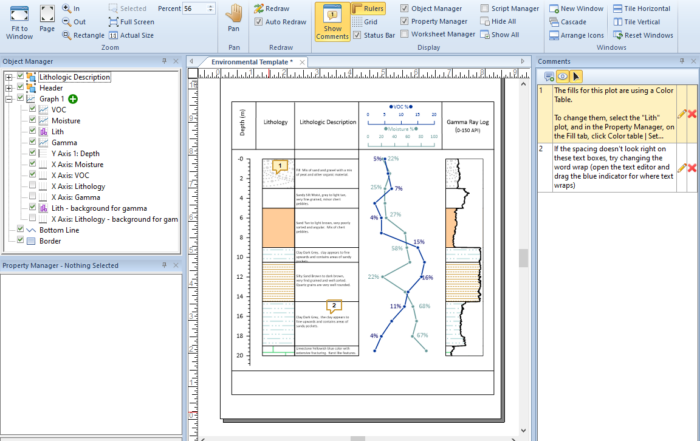
Every key detail—axes, legend, formatting, font styles, and colors—is already built into any template you use or create and share with team members. That means no one has to worry about how you made your graph. The structure is already in place and ready for them to use.
Tech Tip: Want access to customizable, ready-to-use templates and the opportunity to create ones you can repeatedly use and share with team members? The Golden Gallery is for you. Not only will you find a growing collection of templates designed for and by geoscientists and engineers, but you’ll also have the ability to submit templates that fit exactly what fellow colleagues (and industry peers) need.
Team Members Just Plug in Their Data
When you share a template with team members, all they have to do is populate it with their data to get the finished output. Of course, they can make customizations as well, but that’s only if they find it necessary. If they don’t, they’ll have a polished, publication-ready visual in no time.
Templates Make Standardization Easy
When multiple team members create plots, consistency can easily slip. Templates eliminate that risk. They’re perfect for recurring reports, client deliverables, and regulatory submissions, ensuring every graph your team produces aligns with your standards and your organization’s branding—no matter who creates it or what their skill level is.
From Constant Requests to Confident Teamwork: A Real-World Example
Let’s put the benefits that templates bring to teams in perspective with a real-world scenario. A hydrologist decides to download and use a hydrograph template to visualize their data. The final result is a clean, engaging plot that clearly shows streamflow over time, which is exactly what their stakeholders need.
A few weeks later, a junior team member needs to create a similar hydrograph for a different site and asks for help. In the past, the hydrologist would have a few options: stop what they’re doing to recreate the plot themselves, spend time walking their colleague through each step, or give written instructions that may require additional explanation because the team member is too unfamiliar with the graphing software. In all scenarios, time is lost.
Templates fortunately change that situation. Instead of pursuing the time-consuming options, the hydrologist hands their teammate the same hydrograph template they used. The template already includes clear guidance on data requirements, uses proven visualization best practices, and even allows for quick customization to align with any style guidelines or aesthetic preferences your company or stakeholders hold.
With just a few clicks, the junior team member plugs in their data and instantly gets a professional, accurate hydrograph that’s similar to your previous one. There’s no confusion or rework. It’s just a faster workflow and an empowered and equipped teammate.
Related Resources
- Templates: Your New Graphing Go-To (Part 1)
- Templates: Your New Graphing Go-To (Part 2)—How They Reduce the Learning Curve
- Templates: Your New Graphing Go-To (Part 3)—How to Ensure Effective Data Visualization With Templates
- Templates: Your New Graphing Go-To (Part 4)—How Templates Make Recreating Your Plots Easier
Empower Your Team, Reclaim Your Time
Templates motivate your team members to easily create graphs that match the compelling work you’ve previously done for stakeholders. When you give your team this tool, they can produce polished, professional plots on their own without your consistent guidance. That means you no longer have to be the go-to person for every graph your team makes. You can just be the one who sets the team up for success, and that’s a win for everyone involved.